Overview
Thrust Carbon’s NetZero Forecaster tool aims to enhance precision in sustainability planning. It enables Thrust Calculator users to easily predict the future impact of decarbonization options in order to inform travel policy decisions and promote the achievement of net zero goals.
The following guide illustrates the assumptions, calculations and limitations related to each decarbonisation lever in the forecasting model.
How It Works
The forecasting model takes the latest full year emission inventory from Thrust Calculator as the baseline year. The baseline year is calculated using the latest methodology setting in Thrust Calculator. Historical emissions and carbon targets are also integrated from Calculator settings and shown as a layer on graphs to inform pathway definitions.
The decarbonisation levers in the ‘Policies’ section (with the exception of the SAF levers) are applied 100% by the year of full implementation (this year can be chosen by the user), under the assumption that a policy changes all travel behaviour. E.g. mandatory use of economy for all flights under 3 hours.
The model can be used in 2 ways:
To understand the impact of a stand alone policy change.
E.g. If I change the time of flight for economy flights from 2 hours to 3 hours, what is the year on year carbon reduction saving?
To understand the aggregate impact of policy changes in meeting required carbon reduction targets.
E.g. If I were to implement a combination of travel policies, how would this change the likelihood that I can meet my carbon reduction targets?
Next version improvement: The forecasting model will be available for multiple scenarios. That is to say that users will be able to create and save multiple versions of the dashboard in order to illustrate different ways of hitting net zero goals.
Forecast Preferences
Before introducing decarbonisation levers, it is important to assign the forecasting preferences for the company, see guidance below.

These controls can be found under ‘Forecast Preferences’:
Filter by travel type
The tool can be used to create a forecast for an entire travel program or focus on individual travel modes.
Forecast timeframe
Use the control to choose the timeframe for the forecast planning.
Annual business growth
Business Growth settings should be set with estimated year on year expected growth. The value is assigned to travel across all travel modes and all business units.
Next version improvement: Growth projections will be able to be assigned for a given year. E.g. 5% growth in 2026, but 2% growth in 2027.
Next version improvement: Separate growth targets will be able to be specified at business unit level.
Global EV transition
EV stock share (%) from 2025-2035, and extrapolated from 2040-2050.
Data sources: https://www.iea.org/reports/global-ev-outlook-2024/outlook-for-electric-mobility
This is a work derived by Thrust Carbon from IEA material and Thrust Carbon is solely liable and responsible for this derived work. The derived work is not endorsed by the IEA in any manner.
Limitations/Assumptions:
Data is only available up to 2035, and has been extrapolated out until 2050. This extrapolation results in the assumption that all vehicles will be electric by 2045 under both scenarios.
EV Stock Share (%) selected as parameter under the assumption that the greater the stock of EV the increased likelihood of a car or taxi used for business travel being electric.
EV is battery or plug-in electric vehicles but not hybrid.
Aircraft fuel efficiency improvements
Average fuel improvement of the routes group from 2025-2050, including domestic and international routes.
The scenarios represent the total fuel efficiency improvement of aircrafts by 2050, such that a given flight requires X% less in fuel combustion.
Data sources: https://www.icao.int/environmental-protection/LTAG/Pages/LTAG-and-Fuels.aspx
Limitations/Assumptions:
Average of scenario boundary is used, for a given scenario this might result in an under or over-estimation.
The model assumes that progress towards the stated fuel efficiency improvements is linear from the current year to 2050. In reality, fuel efficiency improvement may be slower in the near years and speed up in the 2040s, or vice versa.
Policies
These controls can be found under ‘Policies’:
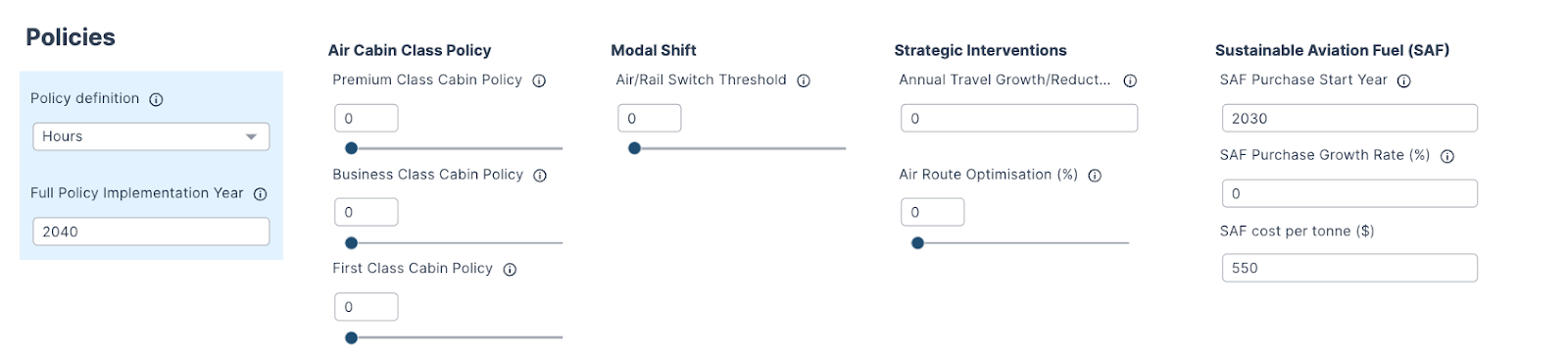
Policy definition
Choose whether levers are ‘time based’ or ‘distance based’. For example when selecting thresholds for air class travel policies.
Distance to time conversion:
For air travel, an average ‘useful’ speed of 740km/h is used. The average cruising speed of an aircraft ranges between 740-925km/h, depending on weather conditions, altitude, aircraft type and other factors (https://flybitlux.com/how-fast-does-a-commercial-plane-fly/), with most sources estimating a speed of 770km/h or faster. Cruising speed is not a direct proxy for travel time, because aircraft must spend time taxiing, circling airports and climbing to cruise altitude etc. It is not possible to identify a single average speed ‘useful’ speed which takes these factors into account. Therefore, 740km/h has been used since it is the lowest cruise speed cited, and is somewhat slower than typical cruise speeds quoted by most sources.
For rail travel, an average ‘useful’ speed of 185km/h is used. This is used as a proxy in order to account for the wide range in trains speeds on different lines and in different countries. Lines not officially designated as ‘high speed’ (250km/h+) but which are viable as an alternative to flying over shorter distances may operate at around 120-150km/h on average including stops (https://en.wikipedia.org/wiki/InterCity_125). On the other hand, some purpose-built long-distance high speed lines in France or China will achieve speeds in excess of 185km/h.
Full policy implementation year
We understand that it might not be realistic to bring in a policy fully next year, therefore this control allows you to define the year in which the policy will be fully realised and assumes linear progress towards full implementation from 2025 until then.
E.g. Phase out all first class travel by 2030 - set first class travel to 20h and this setting to 2030
Limitations/Assumptions:
This lever controls all policy implementation timelines.
Next version improvement: Capability to apply different implementation timeframes for each lever.
Air Cabin Class Policy
In air travel, class switching is among the most impactful levers to organisations at their disposal to reduce emissions from flying.
The class threshold levers allow users to set the minimum time/distance at which travelers may select the given travel class (Premium Economy, Business or First).
An emissions differential will be calculated based on the organisation’s current class mix and the newly-specified class mix.
Limitations/Assumptions:
This lever assumes compliance in a linear progression with class-based travel policies from the current year until full policy implementation year.
The lever allows for only one specified travel class policy, which is applied over the whole forecast period,
Next version improvement: Capability to apply different travel class policies over time. For example between 2025 and 2030 users may set a 4 hour threshold for business class, between 2030 and 2035 they may set a 5 hour threshold, and so on.
Air data that is being calculated with spend is currently assumed to have a distance of 0.
Modal Switch: Air to High-Speed Rail
Travelling by rail is much less carbon intensive than flying.
The Air/Rail Switch Threshold lever allows users to set a threshold (based on distance or train travel time) below which air journeys are converted to rail. An emissions differential will be calculated based on the volume of air travel which would convert to rail in future years.
The model allows air to rail modal shift on specific routes only. If a travel programme does not have air travel on these routes, then this lever will not project emissions reductions in future years when used. The routes have been chosen based on high levels of confidence that viable high speed rail options exist as alternatives to flying.
Data sources: See Appendix 1 for full list of Air to Rail routes
Limitations/Assumptions:
Air to Rail dataset currently only includes -
A set number of rail routes within 3 geographic zones (see Appendix 1). These are based on a high level of confidence as judged internally by Thrust Carbon staff.
Next version improvement: A far greater number of viable routes will be added. Third party evidence will underpin the improved dataset
The reduction potential is calculated assuming that full lifecycle emission factors (combustion + well-to-tank) are used for air and rail.
The reduction potential is calculated assuming Radiative Forcing is not included to be conservative, savings could be greater if RF included. Additionally, UK rail is currently used as a proxy and all values are inclusive of WTT.
Next version improvement: Reduction potentials will be aligned with the individual Thrust Calculator methodology settings.
The reduction potential is calculated using DEFRA 2024 UK emission factors for resulting rail emissions. This may result in an over or under-estimation based on the specific grid mix of the country of rail travel.
Next version improvement: Country specific rail factors
Air data that is being calculated with spend is currently assumed to have a distance of 0.
Annual travel growth/reduction per FTE
Representation of policies or strategies to reduce travel on an intensity basis (per an FTE) or from total company travel.
Data sources: To be input in % by user
Limitations/Assumptions:
Applied to all travel and regions.
Next version improvement: Country and business unit specific
Air Travel Route optimisation
Within air travel there are opportunities to select the most efficient airlines (optimised load factors) and most fuel efficient aircrafts (fuel burn). This lever allows a user to see the impact of this optimization.
Data sources: To be input as an estimate in % by user
Limitations/Assumptions:
Relies on estimate by user
Next version improvement: Automation to inform what a realistic % could be and how this could be realised.
Applied to all travel and regions.
Next version improvement: To be route specific.
Sustainable Aviation Fuel (SAF)
Carbon accounting for Sustainable Aviation Fuel (SAF) is steadily moving toward greater standardization, guided by international frameworks such as ICAO’s CORSIA and IATA’s SAF methodology. These frameworks rely on comprehensive life cycle assessments—covering everything from feedstock cultivation to refining, distribution, combustion, and land-use impacts—to quantify emissions reductions accurately.
However, whilst there are challenges with data availability, a key mechanism enabling broader adoption is the "book and claim" system, which decouples the environmental benefits of SAF from its physical delivery. This allows companies to purchase SAF and account for the associated emissions reductions within their carbon inventories, even if the fuel is consumed elsewhere in the supply chain. This model is increasingly accepted in corporate climate strategies, especially for addressing Scope 3 emissions under the Science Based Targets initiative (SBTi), which include emissions from business travel and freight.
Consequently, in the forecasting model, SAF procurement is treated as a distinct emissions reduction initiative rather than considering scenarios of average SAF usage across all aviation activity.
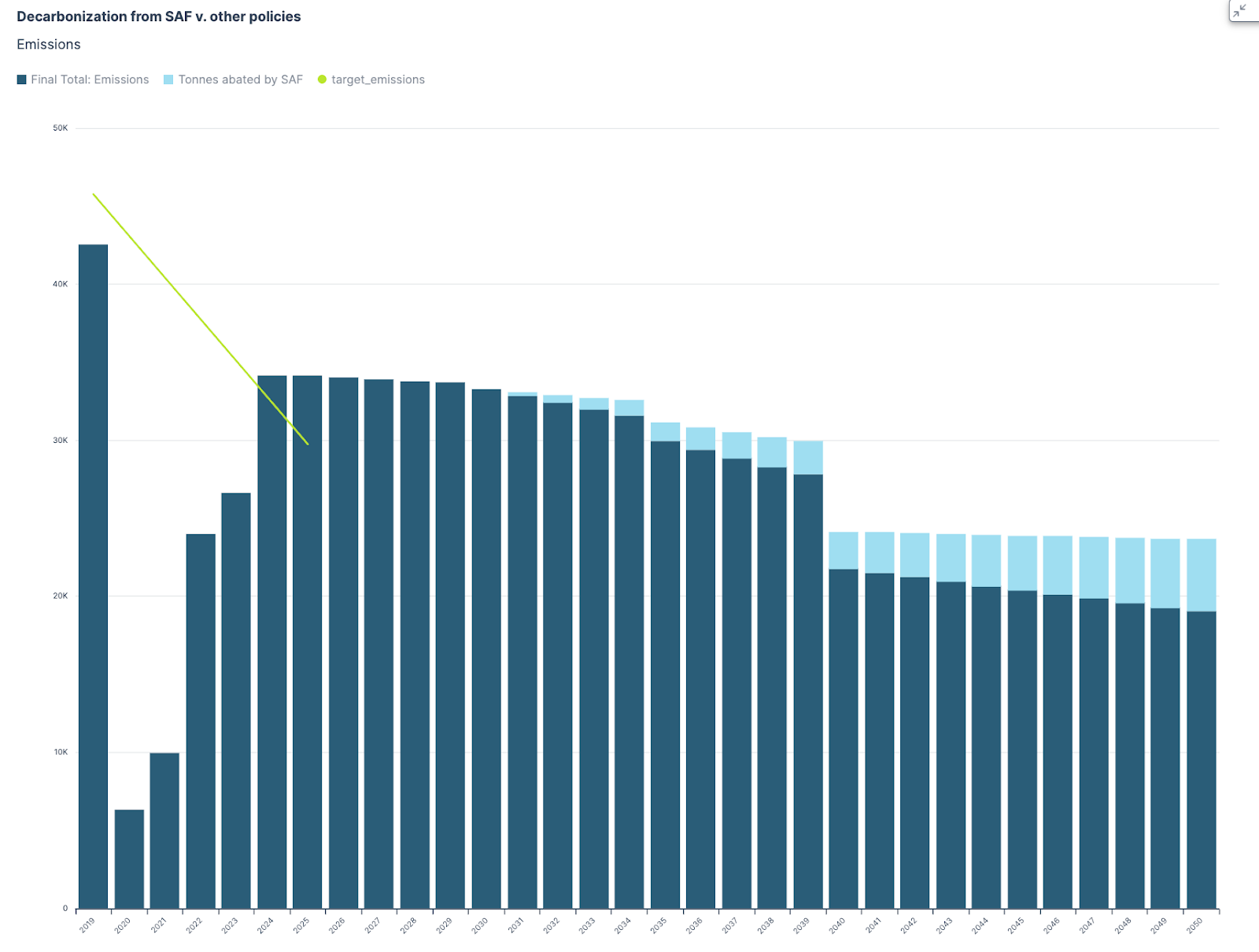
Data sources: To be input as an estimate in % by user
Limitations/Assumptions:
Same price applied across all years of use
Next version improvement: SAF prices per year with the addition of exogenous scenarios for SAF market price projections
Carbon removal quantity and cost modelling
These controls can be found under ‘Carbon Removals’. This relates to high quality carbon removals, not offsets:

Data sources: To be input as an estimate in % by user
Limitations/Assumptions:
Same price applied across all years of use
Next version improvement: Removal prices per year with the addition of exogenous scenarios for removals market price projections
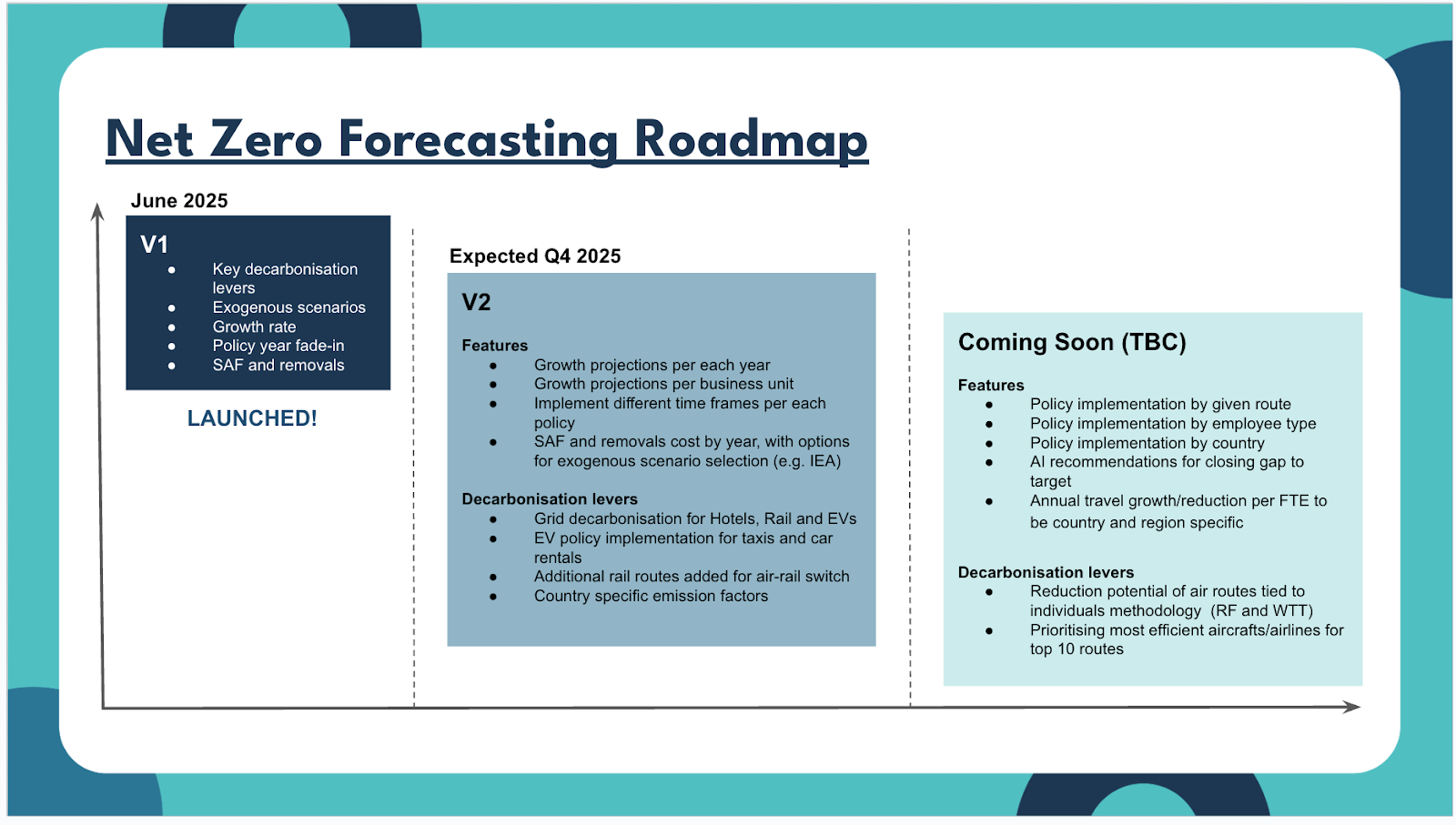
Coming Soon
Indicative Roadmap for development
Missing a key decarbonisation lever? Get in touch with Thrust Carbon to learn how their Net Zero experts can provide tailored decarbonisation modelling to help you reach your Net Zero goals.
Appendix 1 - Potential High Speed Rail Routes
Within each of the below zones, an air journey constituting any of the listed locations for its start and end points is designated as a potential candidate for modal shift from air to rail.
Zone 1: China
PEK: Beijing Capital International Airport
NAY: Beijing Nanyuan Airport
PKX: Beijing Daxing International Airport
PVG: Shanghai Pudong International Airport
SHA: Shanghai Hongqiao International Airport
CTU: Chengdu Shuangliu International Airport
TFU: Chengdu Tianfu International Airport
WUH: Wuhan Tianhe International Airport
SZX: Shenzhen Bao'an International Airport
CAN: Guangzhou Baiyun International Airport
HKG: Hong Kong International Airport (Note: Hong Kong is a Special Administrative Region of China)
XMN: Xiamen Gaoqi International Airport (now Xiamen Gaoqi International Airport is sometimes referred to as Xiamen International Airport)
LYA: Luoyang Beijiao Airport
KHN: Nanchang Changbei International Airport
CKG: Chongqing Jiangbei International Airport
WSK: (No clear match; possibly Wenshan Puzhehei Airport, but not standard code; flagged for uncertainty)
KWL: Guilin Liangjiang International Airport
Zone 2: Europe
LON: London
PAR: Paris
SEN: London Southend Airport (United Kingdom)
LON: (Generic for London; not a specific airport code; flagged for uncertainty)
LHR: London Heathrow Airport (United Kingdom)
LGW: London Gatwick Airport (United Kingdom)
LTN: London Luton Airport (United Kingdom)
LCY: London City Airport (United Kingdom)
STN: London Stansted Airport (United Kingdom)
PAR: (Generic for Paris; not a specific airport code; flagged for uncertainty)
CDG: Paris Charles de Gaulle Airport (France)
ORY: Paris Orly Airport (France)
BVA: Beauvais–Tillé Airport (France, serves Paris)
AMS: Amsterdam Airport Schiphol (Netherlands)
RTM: Rotterdam The Hague Airport (Netherlands)
BRU: Brussels Airport (Belgium)
LIL: Lille Airport (France)
SXB: Strasbourg Airport (France)
NTE: Nantes Atlantique Airport (France)
BOD: Bordeaux–Mérignac Airport (France)
AVN: Avignon Provence Airport (France)
LYS: Lyon–Saint-Exupéry Airport (France)
LBG: Paris–Le Bourget Airport (France)
Zone 3: US
NYC: New York
BOS: Boston Logan International Airport
JFK: John F. Kennedy International Airport (New York)
NYC: (Generic for New York City; not a specific airport code; flagged for uncertainty)
LGA: LaGuardia Airport (New York)
EWR: Newark Liberty International Airport (New Jersey, serves New York City)
PHL: Philadelphia International Airport
BWI: Baltimore/Washington International Thurgood Marshall Airport
DCA: Ronald Reagan Washington National Airport
IAD: Washington Dulles International Airport
Was this article helpful?
That’s Great!
Thank you for your feedback
Sorry! We couldn't be helpful
Thank you for your feedback
Feedback sent
We appreciate your effort and will try to fix the article