Overview:
The Thrust Calculator now includes an innovative feature that allows organisations to account for Well-to-Tank (WTT) emissions, providing a more comprehensive view of the carbon footprint associated with business travel. This feature is instrumental in understanding and reducing the hidden carbon costs of fuel from its origin to its final use in transportation.
What is Well-to-Tank (WTT) and Its Importance:
Definition: WTT emissions refer to the greenhouse gases emitted during the extraction, production, transportation, and refining of fuel before it is used in a vehicle.
Significance: Addressing WTT emissions is crucial as they represent a significant portion of the travel industry's carbon footprint, often accounting for up to 20% of a flight's total emissions. Recognizing and managing these emissions enables businesses to make more informed and sustainable travel decisions.
The Thrust Carbon Approach: Multi-Methodology for Accuracy:
Multi-Methodology Integration: Thrust Carbon has adopted a multi-methodology approach by incorporating both DEFRA and Nature Communications methodologies for calculating WTT emissions. This approach ensures the provision of the most accurate and relevant data to our clients.
DEFRA's WTT Approach:
For clients using the 'DEFRA' air methodology, suitable for compliance needs and operational contexts within specific regulatory frameworks.
Nature Communications WTT Approach for ICAO+:
Recommended for clients aligned with our ICAO+ air methodology, leveraging detailed emissions breakdowns by country and region for unparalleled accuracy in carbon accounting.
Why the Distinction Matters: Choosing between DEFRA and Nature Communications methodologies goes beyond technical preference to strategic alignment. For businesses aiming at sustainability leadership, the Nature Communications approach with our ICAO+ methodology offers the latest and most detailed emissions insights.
Key Benefits of Integrating WTT Emissions
Comprehensive Carbon Footprint Analysis: Enables businesses to fully understand the carbon footprint of their travel activities, considering all emissions from fuel procurement to consumption.
Informed Decision-Making: Assists in making more sustainable travel choices by evaluating the environmental impact of travel routes and modes with greater precision.
Compliance and Reporting: Supports staying ahead of regulatory requirements and standards, such as those set by the SBTi, by incorporating WTT emissions into carbon reporting.
Conclusion: Towards Sustainable Business Travel:
Incorporating WTT emissions into our carbon accounting methodologies marks a significant step forward in our commitment to sustainable travel. By providing a more accurate depiction of the carbon footprint associated with business travel, Thrust Carbon empowers organisations to make decisions that align with their sustainability goals.
1. How to add/edit WTT factors in your instance
To add or edit the well-to-tank factors that are in effect in your instance you need to navigate to the instance settings.
To do this click on the settings button next to the instance you want to edit, as shown below.

You can also access the settings from within the instance as shown below.

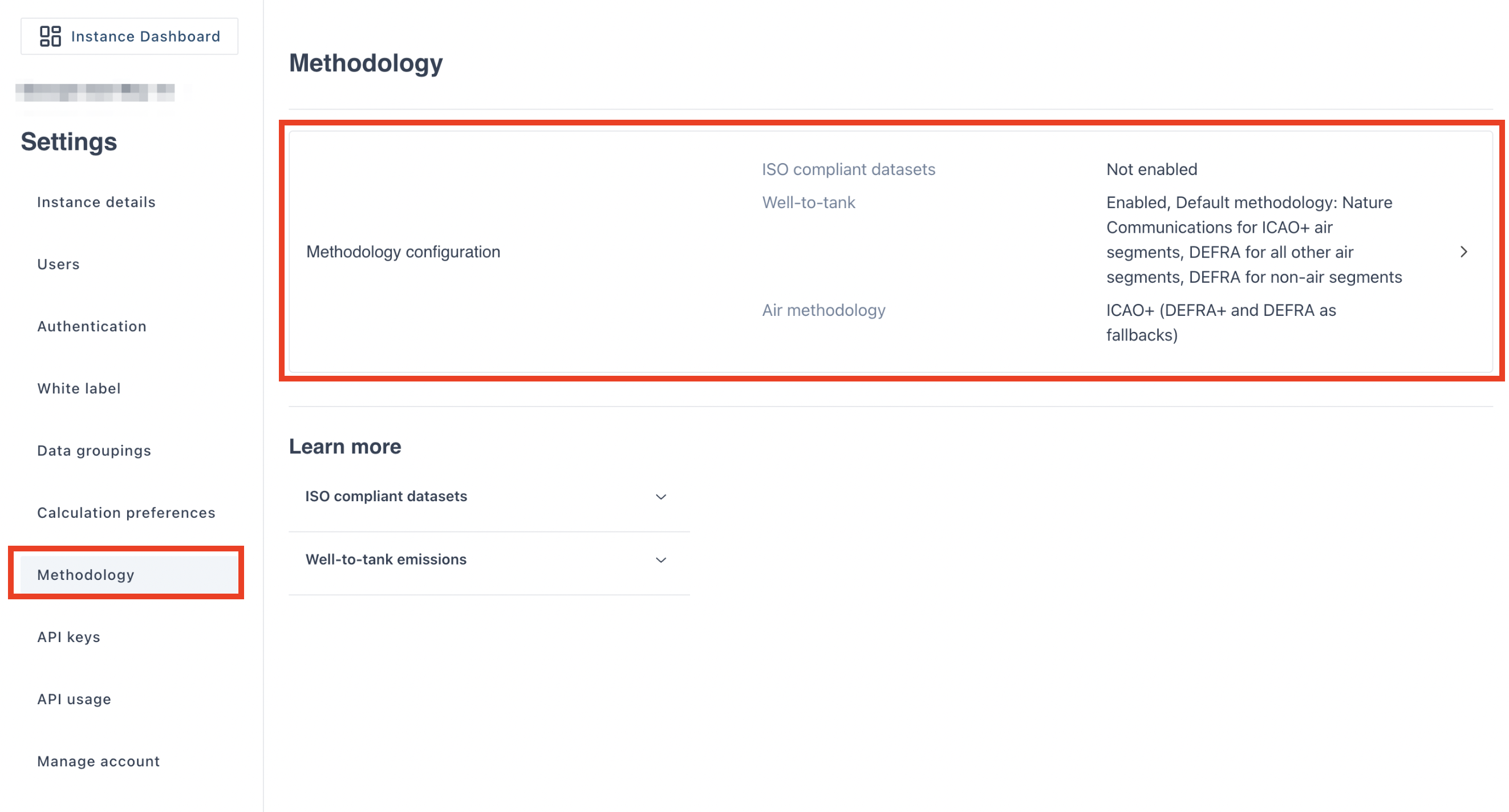
Once you are in the Settings, you need to click on the “Methodology” page as shown below. Then click on the "Methodology configuration" box.
This will reveal a pop-out of different configurations that can be chosen. Check the “Enable well-to-tank emissions” to expand the options available. Simply select the methodology you wish to be applied to the segments in your instance.
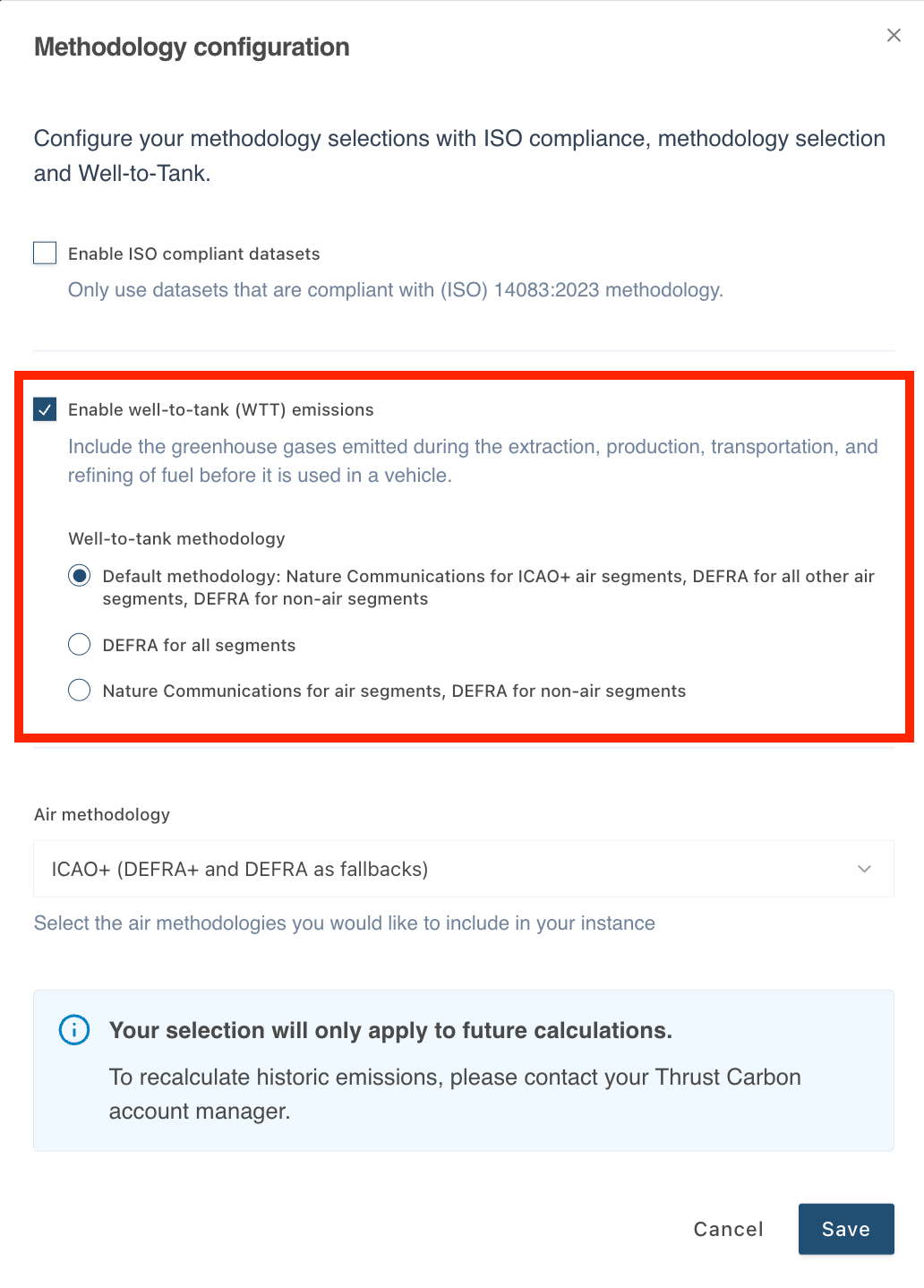
The methodology options to choose from are:
DEFAULT: This will apply the Nature Communications methodology to ICAO+ air segments while DEFRA will be applied to all other segments, including DEFRA and DEFRA+ air segments.
DEFRA: This will apply the DEFRA WTT factors to all the segment types in your instance.
Nature Communications: This is only available for air segments, if this methodology is chosen DEFRA will still be applied to all other non-air segments.
Once you have confirmed your selections, press the save button.
Was this article helpful?
That’s Great!
Thank you for your feedback
Sorry! We couldn't be helpful
Thank you for your feedback
Feedback sent
We appreciate your effort and will try to fix the article